
Kelpie

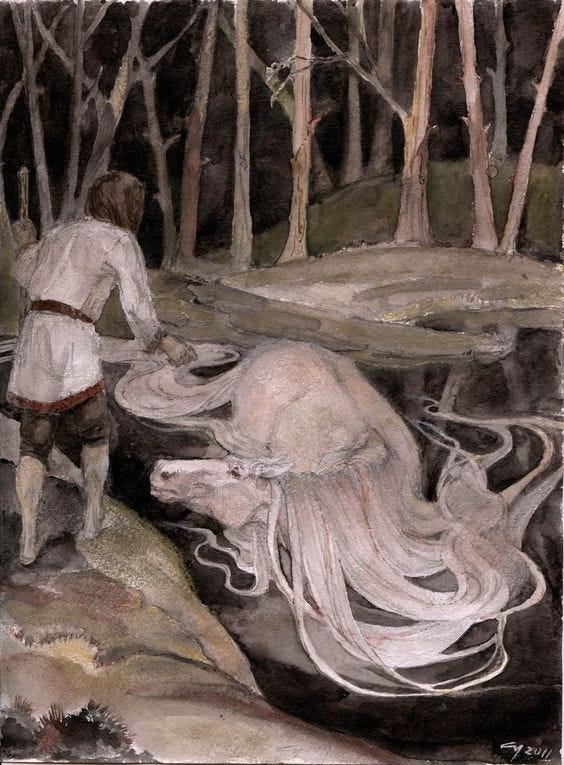
You wouldn't think you'd need a monster to justify telling people not to go swimming in Irish or Scottish lakes.
Nevertheless, according to folklore across the Isles, there're worse fates for those wading into the local water, aside from bitter cold and some fascinating new diseases. In the case of the Kelpie, the fate on offer is a very messy one indeed.
Like many mythological creatures, and especially fae creatures, the Kelpie is a shapeshifter, capable of taking a variety of forms, but it has it's favourites. The first, and most iconic of these forms, is a large horse, a powerful black steed wading through the river or stream, coincidentally covering up it's one giveaway, reversed hooves on it's legs. Other times, the Kelpie attempts a more seductive approach, taking the form of a handsome man, sometimes a woman, with only the presence of water reeds in their hair giving a clue to their true nature.
Regardless of the form they take though, the Kelpie's goal is always the same. To get you into the water.
Should you make the mistake of mounting the horse, or following the handsome stranger into the river, the Kelpie will seize hold, dragging you under the water. If you're lucky, they'll wait until you drown before they start to eat you, because the Kelpie is a messy eater, you're entails or organs bobbing to the surface after the Kelpie has finished it's latest meal.
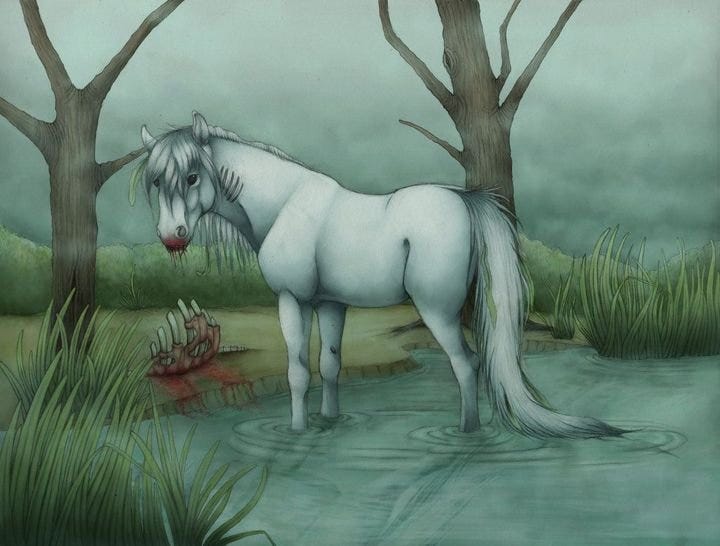
And don't bother just trying to jump off the horse if it starts swimming to deep water. In one of the classic Kelpie tales, where one lures several children onto it's back at once, one hangs back, just petting it, only to realise his hand has adhered itself to the Kelpie's mane. In most versions of this story, the boy saves himself by cutting off the finger or hand stuck to the Kelpie, while the other children are helpless to prevent their gristly fate.
Fortunately, there are ways to combat the Kelpie (I mean, aside from just not following strange animals or people into lakes). For starters, the classic fae weakness to iron holds true for Kelpies, with one story telling of how a blacksmith, his family long terrorised by nightly visits from a Kelpie, heated two iron spears in his forge, then ambushed it the following night, stabbing the Kelpie on both sides, it's body immediately dissolving into water foam.
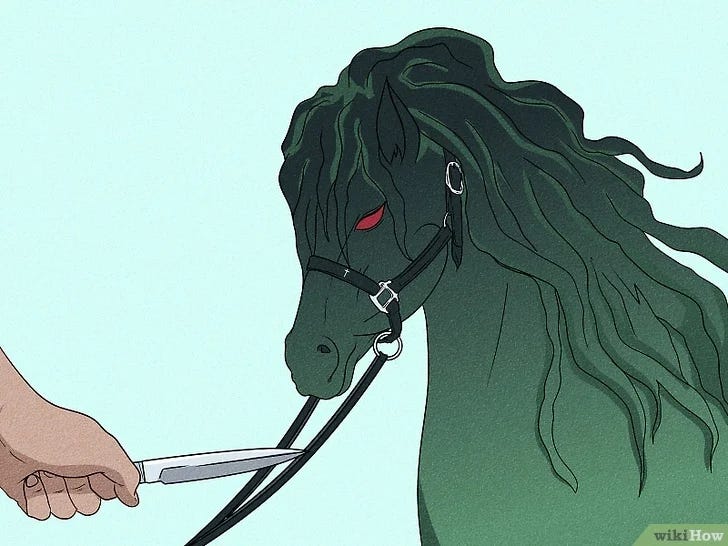
Some stories go even further, not simply killing the Kelpie, but taming it. Every Kelpie wears a bridle around it's head, which depending on the legend, is the source it's shapeshifting powers. By stealing this bridle, you would bind the Kelpie to it's current form, and in the process, can demand nearly anything of it in return for the bridle.
According to folklore, one man, the Laird of Morphie, managed just this, severing a Kelpie's bridle and pressing the now powerless Kelpie into service, forcing it to pull stones day and night to build a castle. Upon completing, he returned the bridle, which did little to spare him the Kelpie's fury for working it to near death. The Kelpie cursed him with it's parting words, and allegedly, his descendents were plagued by misfortune until the death of his family line.
Some versions of this story don't end in misfortune for the trapper. In one folk tale from Barra, a young girl is wooed by a Kelpie, but manages to steal his bridle in the form of a silver necklace, trapping him in his horse form. Like the Laird of Morphie, the Kelpie is sentenced to a years worth of work on the girl's father's land. Upon the end of this year, the girl rides the Kelpie to see a local wise man, who recommends returning the bridle, but also asks the Kelpie if he'd prefer to be Kelpie or human. The Kelpie, possibly under the effects of Stockholm Syndrome, asks the girl if she'd marry him if he chose to be human, and, upon hearing a yes, forsakes his Kelpie nature, becoming the girl's husband.
As you may have noticed, despite being born a Scottish legend, I mentioned variations of the Kelpie appear across the Isles, though none of them are particularly friendly. In Ireland, the Kelpie is known as Each-uisge, and operates fairly similarly to Kelpie, though is perhaps a bit more cunning, some Each-uisge being said to hide among herds of horses to attract a rider that way, before swiftly making their way back to the water for din-dins.
The Welsh version, known as Ceffyl Dŵr, uses a noticeably different method than it's cousins. Still a shapeshifting predator, the Ceffyl Dŵr prefers to lurk near waterfalls, again enticing a rider to mount it. Upon the rider doing so, the Ceffyl Dŵr instead takes flight, giving the rider a no doubt amazing view of the waterfall, before turning into mist, casting the rider to a messy death on the ground. In this case, there's not even direct mention of the Ceffyl Dŵr eating the rider afterward, though maybe it simply prefers pureed food.
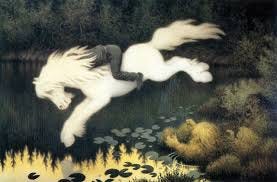
Perhaps the most famous individual example of a Kelpie, however, is said to lurk in one specific lake or river. According to tales from the 19th century, a highlander by name of James Macgregor, ran afoul of a Kelpie by Loch Ness, who had been terrorising the area for some time. Like many others, however, Macgregor was wily and quick enough to sever the Kelpie’s bridle, binding it to a horse form, taking the bridle back to his home, despite the Kelpie’s curses and threats, it being powerless to enter the home as it had a cross above the entrance. So the tale goes, the bridle existed in Macgregor’s family for generations, giving them access to fae powers and magical healing. Mind you, if the Kelpie ever got that bridle back, who knows what forms it might take afterwards, especially after humans became less trusting of water horses and more interested in other mysterious sea life...
The Kelpie is, in many ways, an archetypal fae monster, representing both the capricious and dangerous nature of the fae, as well as a cautionary tale of avoiding deep waters, and especially not trusting anything that would lure you into the depths. Given how many die by drowning even today, perhaps it’s not unreasonable for our ancestors to assign a malevolent being to those rivers and lakes known to take lives, perhaps better to believe your brother or friend was taken by a monster, rather than by the cruel whims of bad luck or poor footing.
https://archive.org/details/popularrhymessc01chamgoog/page/n340/mode/2up?view=theater
The Celtic Breeze: Stories of the Otherworld from Scotland, Ireland, and Wale by Heather McNeil
https://archive.org/details/notesonfolklore00greggoog/page/n92/mode/1up?view=theater
https://themourningpaper.co.uk/2025/01/06/each-uisge-a-sleek-and-deadly-steed/
https://archive.org/details/afl2317.0001.001.umich.edu/page/58/mode/2up
https://archive.org/details/popularsuperstit00stewuoft/page/102/mode/2up?view=theater